Inside the Nasrid Palaces: Rooms, Architecture & Highlights
The heavy cedar door swings open, and suddenly the dry heat of Andalusia disappears. Stepping inside the alhambra palace feels less like walking into a preserved European museum and more like sliding into an intricate, layered world built entirely around shadow, running water, and sculpted plaster. Most visitors arrive expecting vast stone ballrooms like Versailles. Instead, you get a labyrinth of intimate chambers where water trickles through narrow marble channels cut right into the floor tiles, cooling the mountain air naturally.
What we casually call the "palace" is actually three distinct royal compounds fused together over nearly 250 years. The sultans tore down walls, rebuilt wings, and redecorated continuously as dynastic fortunes swung up and down. This guide walks you through every major room across the Mexuar, Comares, and the Palace of the Lions. We will look at the engineering quirks, the hidden chambers, and where the light falls best for taking your own alhambra photos along the one-way visitor route.
Book your nasrid palaces experience:
The Mexuar: Stepping Inside the Alhambra Palace Complex
Your ticket gives you an exact 30-minute entry window. Once the guards scan your barcode at the Puerta del Vino gate, you funnel straight into the Mexuar. It is the oldest surviving section of the royal grounds. Originally built by Ismail I around 1314 and reworked by Muhammad V, this hall served as a public administrative court. Ordinary citizens brought grievances and petitions right to this threshold, which explains why the space feels comparatively grounded and sober.
Look up as soon as you step across the threshold. Four central marble columns carry ornate capitals that support a dark, heavy wooden ceiling carved in the Mudéjar style. Christians heavily altered this room after the Reconquista in 1492, converting the council chamber into a makeshift chapel. You can spot where Islamic plasterwork abruptly stops and Renaissance crests take over on the upper walls. At the far northern end, a delicate prayer room looks out toward the Albaicín hillside. The plaster archways framing the small windows are carved with verses from the Quran, set at eye level so a kneeling worshiper would see them while facing Mecca.
Just past the council chamber sits the Golden Room Courtyard in the Nasrid Palaces, or Patio del Cuarto Dorado. For many travelers exploring alhambra granada inside for the first time, this courtyard is the moment the complex clicks. Standing in the patio del cuarto dorado in the nasrid palaces, you face an imposing two-story facade carved entirely in stucco. The sheer density of geometric carving is mind-boggling. Scholars spent decades cataloging the calligraphy here, finding poetry, royal mottos, and Quranic verses braided into repeating floral arabesques.
Pro tip: Pause on the south side of the Golden Room Courtyard before walking through the portal. Turn around to look at the wooden eaves overhead, which were carved from Spanish cedar in the late 1300s and still smell faintly spicy on warm afternoons.
Comares Palace and the Hall of the Ambassadors
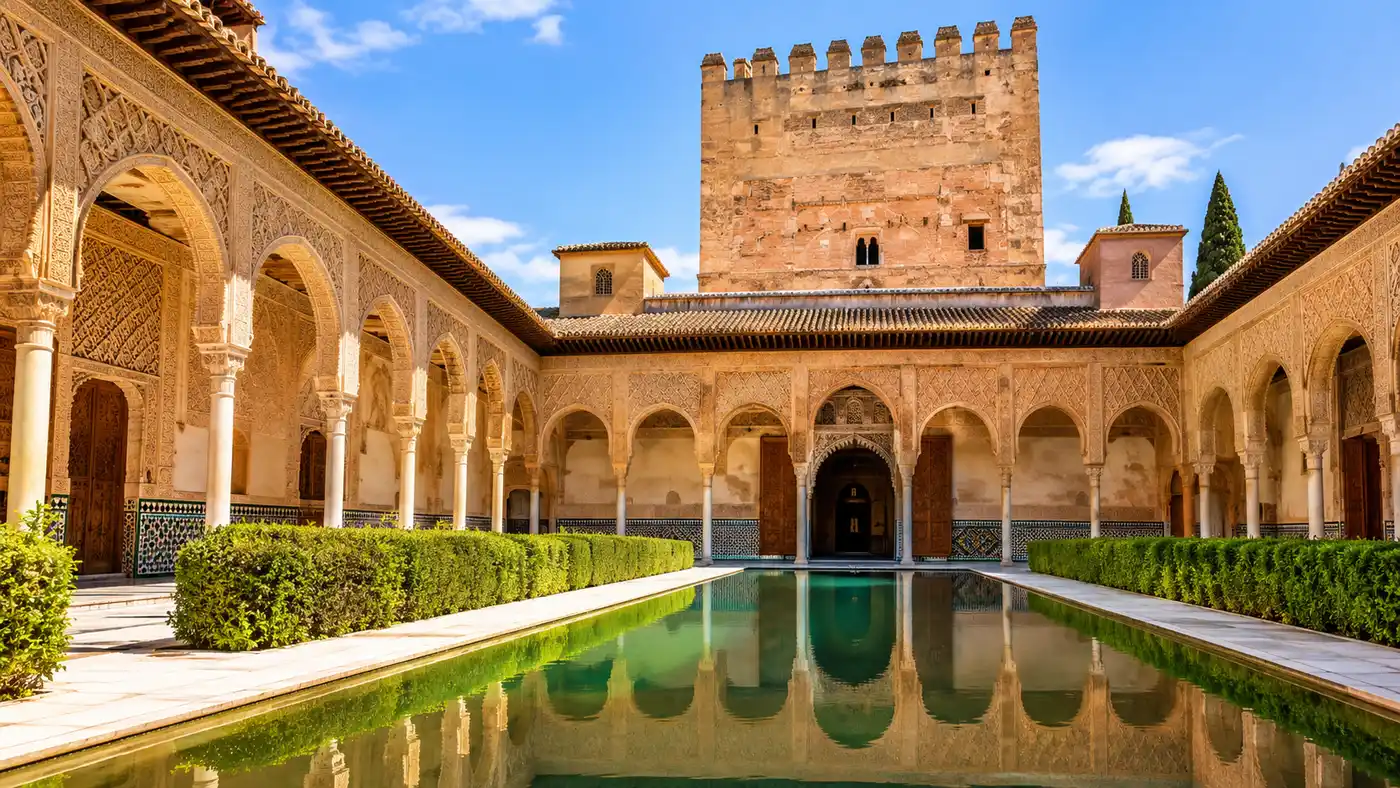
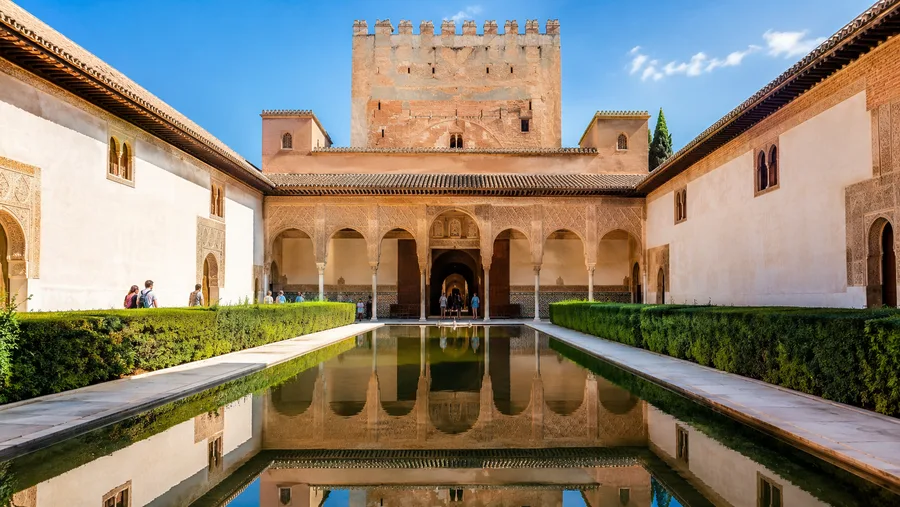
Passing through the double dogleg entry of the Comares facade brings you into the grand political center of Islamic Spain: the Court of the Myrtles (Patio de los Arrayanes). Everything here shifts from intimate administration to regal theater. A rectangular pool stretches 34 meters down the axis, flanked by trimmed myrtle hedges that give the court its sweet, herbal scent. The smooth sheet of green water acts like a gigantic mirror. When the wind drops, the towering Comares Tower reflects cleanly across the surface, giving architects an ingenious way to double the perceived height of the building without quarrying extra stone.
Inside the base of that massive tower lies the Hall of the Ambassadors (Salón de Embajadores). This was the official throne room of Yusuf I. Envoys walked down the long, dim corridor to kneel before the Sultan, who sat framed directly against a bright arched window overlooking the Darro valley below. Because the light source sat directly behind the ruler, foreign dignitaries could barely see his face, while he could read every twitch of theirs. It was psychological warfare executed through brilliant masonry.
The ceiling above your head deserves several quiet minutes of study. Built using more than 8,000 tiny cedar pieces joined without a single iron nail, it represents the seven heavens of Islamic cosmology. Geometric stars spiral inward toward a central cupola that represents the throne of God. It survived several earthquakes and half a millennium of neglect. If you want striking alhambra granada photos, stand in the back corner of this room and point your lens upward at a 45-degree angle during late morning when soft daylight bounces off the tiled floors onto the cedar dome.
| Room or Courtyard | Primary Era Built | Architectural Focus | Best Light for Photos |
|---|---|---|---|
| Mexuar & Oratory | Early 1300s (Ismail I) | Mudéjar woodwork, prayer alcove | Early morning, low glare |
| Patio del Cuarto Dorado | 1370s (Muhammad V) | Intricate stucco facade | Midday, direct overhead sun |
| Court of the Myrtles | Mid-1300s (Yusuf I) | Reflective pool, Comares Tower | Late afternoon, calm water |
| Hall of Ambassadors | Mid-1300s (Yusuf I) | 8,000-piece cedar dome | Late morning, reflected ground light |
| Court of the Lions | Late 1300s (Muhammad V) | 124 marble columns, fountain | Early morning, soft shadows |
| Hall of the Abencerrages | Late 1300s (Muhammad V) | Stalactite muqarnas vaulting | Overcast days, diffused skylight |
The Palace of the Lions: The Heart of the Nasrid Palace Interior
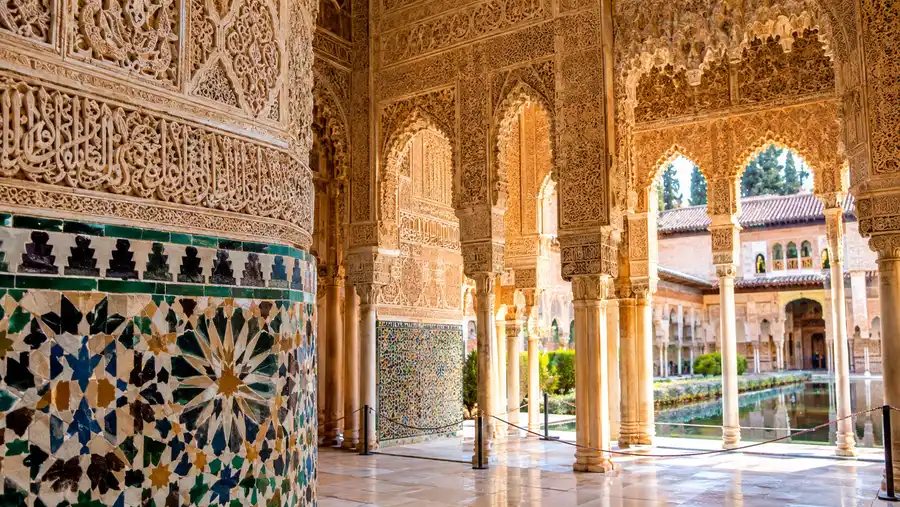
Muhammad V returned to power in 1362 after living in exile in Fez, and his exposure to North African and Christian Castilian craft traditions shaped his masterwork. The Palace of the Lions represents the absolute peak of the nasrid palace interior. Unlike the stately symmetry of Comares, this palace was private residential territory, designed for leisure, poetry recitals, and private family life.
The courtyard centers around 124 slender white Macael marble columns arranged in clusters of single, double, and triple shafts. Instead of rigid classical columns, these resemble delicate forest glades holding up carved lace arcades. Water flows from four raised perimeter fountains toward a central basin resting on the backs of twelve stylized marble lions. The fountain itself doubles as a hydraulic clock, engineered so water spouted sequentially from different beasts to mark passing hours. Conservators restored the entire water circulation system around 2012, so water runs today just as it did in 1380.
Flanking this courtyard are three jaw-dropping domed chambers that showcase the peak of Islamic plaster craft:
- Hall of the Abencerrages: named after a noble family slaughtered here during palace feuds, featuring a sixteen-sided star ceiling that drops into hanging honeycomb stalactites (muqarnas).
- Hall of the Kings: tucked along the eastern wall, famous for its leather-painted ceilings showing chivalric scenes painted by Christian artists hired by the Sultan.
- Hall of the Two Sisters: home to a vault containing roughly 5,000 individual plaster muqarnas cells, calculated mathematically to disperse sound and diffuse sunlight from high clerestory windows.
Standing beneath the dome in the Hall of the Two Sisters honestly gives people vertigo. The ceiling doesn't look like solid plaster; it looks like frozen smoke or crystals forming under frost. To understand the deep historical forces that produced these spaces, reading up on the history of the Nasrid Palaces adds incredible context to the architectural choices Muhammad V made here.
Book your nasrid palaces experience:
The Nasrid Palace Hammam and Hidden Corners
Past the grand public state rooms, the route winds through narrow domestic corridors toward the nasrid palace hammam granada. Steam baths played a central role in Nasrid daily life, serving ritual purification needs before prayer as well as quiet political dealmaking. The bathhouse, also called the Baño de Comares, mimics the traditional Roman sequence of cold, warm, and hot chambers.
While access to the lower steam chambers is often restricted to protect the fragile subterranean flooring, you can peer through grated openings into the Sala de las Camas (Room of the Beds). The chamber holds colorful tile dadoes, arched resting platforms, and a raised wooden gallery where musicians played while the sultan rested. Above, star-shaped skylights pierced through the barrel-vaulted ceiling vented the humidity. Originally, these star cutouts held colored glass panes that cast dancing colored beams across the rising steam.
Leaving the hammam area, the one-way walkway pushes you through the Lindaraja Courtyard and into the set of rooms once occupied by American writer Washington Irving in 1829. His sketches and romanticized writings essentially kickstarted nineteenth-century European tourism here, saving the monument from decaying into an abandoned barracks. The view through the Lindaraja Mirador looks down onto a quiet garden planted with cypress, boxwood, and orange trees surrounding a Renaissance fountain.
Pay close attention to the structural layers as you walk through these transitions. Craftsmen worked with four primary materials, layered meticulously from floor to sky:
- Glazed ceramic zellige tiles: cut by hand into geometric stars covering the lowest 4 to 6 feet of wall where visitors might brush past.
- Carved stucco plaster: composed of gypsum, marble dust, and slaked lime, filling the mid-wall regions with endless epigraphic calligraphy and vegetal arabesques.
- Polychrome paint: originally highlighting every carved leaf in vivid cinnabar red, lapis lazuli blue, and leaf gold, though centuries of sunlight have faded them to warm bone white.
- Inlaid cedar ceilings: constructed using tongue-and-groove joinery to prevent thermal warping from Granada's severe winter freezes and blistering summer afternoons.
Note: Flash photography and selfie sticks are strictly banned inside all rooms of the palaces. Security guards monitor every room via cameras and will blow whistles or make you delete photos if they catch you using flashes, which degrade the ancient pigments on the stucco.
Photography Tips for Snapping Alhambra Photos Inside
Getting clean alhambra spain photos requires patience, planning, and an understanding of how crowds move through the rooms. The site limits entry to 300 visitors every half hour. That means a fresh wave of people floods the Mexuar every thirty minutes like clockwork. If you want empty corridors or clean reflections in the pool, you have to time your steps around those arrival surges.
The light inside the complex changes dramatically between morning and evening. Because the palaces sit on the southern slope of the Sabika hill, rooms facing the Albaicín (like the Hall of the Ambassadors and the Lindaraja balcony) get direct northern ambient light, which stays consistent all day. The Court of the Lions, by contrast, gets scorched by harsh southern sun between 1:00 PM and 4:00 PM. High noon blows out the pale marble columns, turning your photos of alhambra granada spain into washed-out, high-contrast images with harsh dark shadows under the arcades.
If you have flexibility when booking your slot, pick the first morning entry at 8:30 AM or an afternoon slot around 5:00 PM. For deeper advice on booking windows and seasonal hours, check our breakdown on visiting the Nasrid Palaces before you lock in dates. During golden hour, the sun hits the red sandstone walls of the outer battlements, casting a warm peach glow across the inner patios that makes nasrid palaces photos look like paintings.
Shooting inside alhambra palace interiors means dealing with extreme dynamic range. You are often standing in a shadowy room trying to capture a sunlit courtyard framed through an arched horseshoe doorway. Meter your camera for the midtones on the carved plaster rather than the blazing courtyard outside. If you use a smartphone, tap the screen on the shadowed archway, then drag the exposure slider slightly downward to preserve the delicate stucco detail without blowing out the highlights outside.
Wander slowly. Most guided tours march through the entire interior circuit in 45 minutes, but staying 90 minutes gives you breathing room between groups. When a noisy tour group clears out of the Hall of the Two Sisters, wait three minutes. You will often get a 60-second window of absolute silence where you can hear the water fountain bubbling and take la alhambra photos without stray elbows in your frame. It transforms the experience completely.
Frequently Asked Questions about inside the alhambra palace
How long does it take to walk through the Nasrid Palace interior?
Most travelers spend between 75 and 90 minutes inside the palaces. The route is strictly one-way, and once you exit past the Lindaraja courtyard into the Partal gardens, you cannot re-enter the interior rooms on the same ticket.
Can you touch the carved plaster and tile walls inside?
No. Natural oils from human hands break down the delicate gypsum plaster and rub off microscopic glaze fragments from the ancient zellige tiles. Ropes and clear glass barriers protect the most fragile sections, and staff actively enforce hands-off rules.
Are the rooms inside the Nasrid Palaces wheelchair accessible?
Partially. The monuments have an adapted itinerary for travelers with reduced mobility that covers the Mexuar, the Court of the Myrtles, and the Court of the Lions. A few transition stairwells require assistance, so check in with the entrance pavilion to get the dedicated accessibility map.
Quick Reference
- Entry strictly tied to the 30-minute window on your ticket.
- One-way walking route takes about 75 to 90 minutes.
- No tripods, selfie sticks, or flash photography permitted inside.
- Best natural lighting hits the interior patios before 10:00 AM and after 5:00 PM.
Book your nasrid palaces experience:
My Take on the Palaces
No matter how many photos of alhambra palace halls you browse before your trip, nothing prepares you for the soundscape. The water here is not merely decorative; it is a structural cooling system and an acoustic shield that muffles footsteps. Take your earphones out, resist the urge to document every single carved medallion on your phone, and spend at least ten minutes just leaning near the myrtle hedges listening to water run through marble gutters. That sensory interplay is the true genius of Moorish Granada, and it stays with you long after the plane ride home.
Read more about nasrid palaces.