History of the Nasrid Palaces and the Alhambra
I still remember standing in the Court of the Lions around 4:30 in the afternoon, watching the sun hit the honey-colored plasterwork while the tour groups thinned out. The silence that settles over the palace when people stop talking is haunting. It makes you realize that understanding the nasrid palaces history is not about memorizing dates of conquests. It is about understanding how a dynasty on the brink of extinction poured every ounce of its soul, fear, and poetic genius into clay and cedar before the lights went out forever.
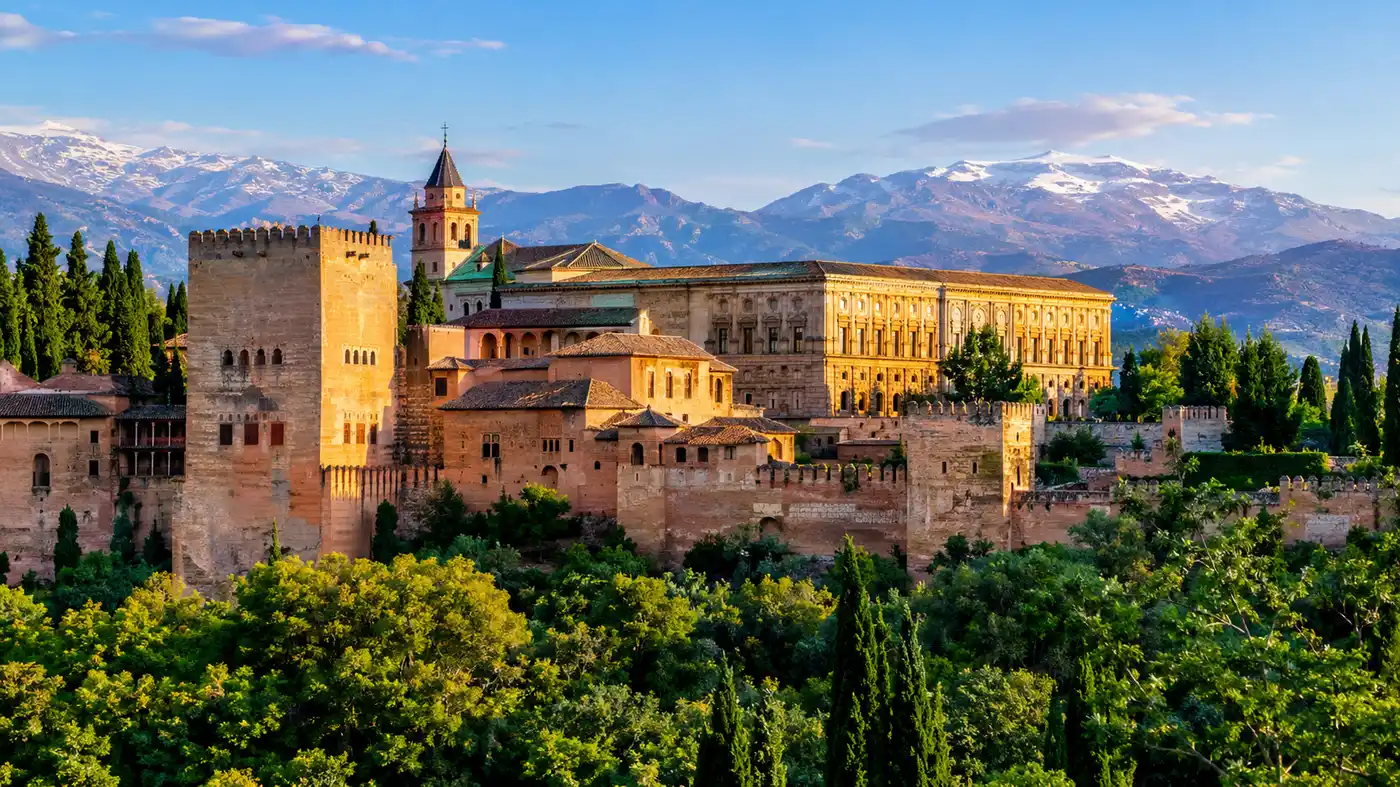
Most travelers arrive thinking the complex was thrown up all at once as a singular medieval fortress. It was not. The red citadel on Sabika Hill grew over two and a half centuries in fits and starts, driven by shifting alliances, family assassinations, and an encroaching Christian front line. If you want to make sense of what you see on the hill today, you have to peel back the layers left by the twenty-two rulers who called this mountain spur home.
Book your nasrid palaces experience:
Origins of the Red Hill: What Is the Alhambra?
The name itself gives away its physical reality. People often ask about the meaning of Alhambra, or search for some grand Arabic translation. It comes from al-Qal'at al-Hamra, which simply means "the red fortress." The rammed earth walls were mixed with local red clay and gravel from the Darro riverbed below. In midday heat, the ramparts look dusty ochre, but just after sunset or during an autumn rainstorm, the brickwork turns deep crimson. That simple visual gave the hill its identity long before the palaces existed.
Early Roman fortifications once occupied this ridge. A small 9th-century fortress stood here during the turbulent years of the Cordoba Caliphate, largely neglected while the lower city along the river flourished. Everything shifted in 1238. Muhammad I, known as Ibn al-Ahmar, rode into Granada after the fall of Jaén. He founded the Nasrid dynasty, the last Muslim ruling house in the Iberian Peninsula. He took one look at the crumbling ruins of the old Alcazaba garrison on the high bluff and saw an unassailable redoubt.
Water changed everything. Ibn al-Ahmar did not just build ramparts; he diverted the Acequia Real (Royal Canal) six kilometers from the Darro river, lifting water against gravity through hydraulic engineering to supply the citadel. Without that canal, the fortress would have been an arid, uninhabitable rock. With it, the hill bloomed with orchards, fountains, and royal baths.
Pro tip: Walk along the Calle Real inside the fortress walls near the church of Santa María. If you peek through the roadside grates, you can still hear the water rushing through the original stone conduits built in the 13th century.
The Golden Age: Yusuf I and Muhammad V
The palace complex you walk through today was not the work of the early warrior kings. It belongs to the 14th century, a strange and fragile golden age. Yusuf I and his son Muhammad V ruled the Emirate of Granada during a rare window of diplomatic balance between Castile and North Africa. Knowing their borders were shrinking, these two sultans directed their wealth inward. They transformed the fortified hilltop into an architectural mirage.
Yusuf I gave us the imposing Comares Palace. This was the seat of state power. When foreign ambassadors walked into the Hall of the Ambassadors, they stepped onto glazed ceramic tiles beneath an astounding cedar dome made of 8,017 individual wooden pieces fitted together like a celestial jigsaw. Yusuf wanted them to feel tiny, vulnerable, and overwhelmed by God's majesty. He died in 1354, stabbed in the back by a madman while praying inside the royal mosque on the hill.
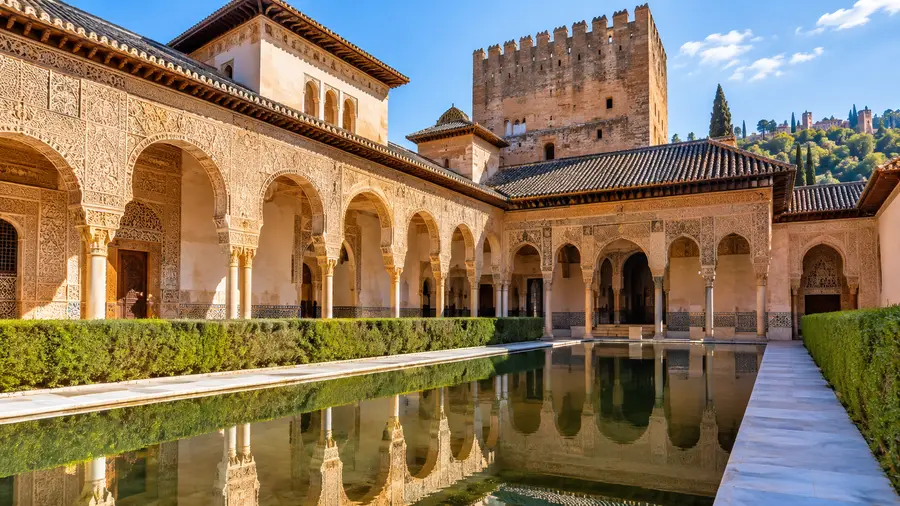
His son, Muhammad V, had a different aesthetic vision. Exiled to Fez for three years after a bloody palace coup, he returned with refined tastes in Marinid geometry, Italian marble, and courtyards designed for domestic pleasure rather than political intimidation. He built the Palace of the Lions. In our guide to the rooms and architecture inside the Nasrid Palaces, you will see how this shift toward delicate, lace-like stucco redefined Spanish Islamic art.
The differences between these successive royal building campaigns can be mapped directly to how each monarch governed:
| Monarch | Reign | Key Structural Additions | Primary Purpose |
|---|---|---|---|
| Muhammad I | 1238–1273 | Alcazaba watchtowers, Acequia Real | Military defense and basic water supply |
| Muhammad III | 1302–1309 | Partal Palace and original grand mosque | First lakeside royal residence |
| Yusuf I | 1333–1354 | Comares Tower, Gate of Justice | State diplomacy, ceremonial reception |
| Muhammad V | 1354–1391 | Court of the Lions, Lindaraja mirador | Private royal quarters, poetic retreats |
Life inside these walls was not quiet meditation. Sultans lived under constant threat of assassination from rival factions of the Banu Sarraj family - the Abencerrages - and ambitious half-brothers. Walls were built thick not only to keep the Christians out, but to keep royal guards and scheming viziers contained.
The Fall of 1492 and Christian Adaptation
By late 1491, the Emirate was finished. Muhammad XII, known to Western history as Boabdil, found himself besieged by the Catholic Monarchs, Ferdinand and Isabella. Supplies were depleted, his nobles were bickering, and the countryside had burned. On January 2, 1492, Boabdil quietly handed the keys of the fortress to Ferdinand in exchange for safe passage into the Alpujarras mountains.
A persistent legend says Boabdil paused on a rocky pass called the Suspiro del Moro, looked back at the red towers, and wept, prompting his mother Aixa to tell him to weep like a woman for what he could not defend as a man. Honestly, Spanish chroniclers probably invented the speech years later to dramatize the surrender, but the emotional reality holds up. It was the end of nearly eight centuries of Muslim governance in Iberia.
Note: While many guidebooks claim the Catholic Monarchs immediately demolished Moorish structures, Isabella actually ordered the Nasrid Palaces preserved, adopting Moorish dress within the palace walls and using the complex as her court headquarters for years.
Christian modifications began almost immediately, though they were more subtle than you might expect at first. The royal mosque was demolished in 1492 to erect the Church of Santa María de la Alhambra. The sultans' private baths were converted to private chambers. Decades later, Emperor Charles V, grandson of Isabella, made the most drastic intervention. He leveled a section of the winter palace to construct his colossal Renaissance palace. It sits right beside the delicate Nasrid rooms like a Roman stone coliseum dropped next to a silk tent.
If you want to understand how the surrounding royal estate fits into this timeline, including the orchards across the ravine, spending an afternoon walking the Generalife Gardens and Alhambra grounds shows you how the Christian monarchs maintained the agricultural terraces while changing the plant life entirely.
Book your nasrid palaces experience:
Decay, Romantic Travelers, and Restoration
The 18th century was brutal to the site. The Bourbon kings had no interest in Granada. They moved the court to Madrid, abandoned the hilltop suites, and left the complex to squatters, smugglers, and thieves. Rooms that once housed viziers were used as livestock pens. Gypsies and outcasts lit cooking fires against priceless plasterwork, blackening the intricate calligraphic scripts with soot.
Worse came with Napoleon. French troops occupied the fortress from 1810 to 1812 during the Peninsular War. When the British army forced them out, the retreating French garrison mined the outer fortifications. Eight defense towers were obliterated in an instant. A Spanish disabled soldier named José García managed to stomp out the fuses leading to the main palace quarters just before they caught fire, saving the core royal complex from total annihilation.
- Washington Irving's residency: In 1829, the American author moved into the abandoned rooms, writing his famous Tales of the Alhambra and sparking international curiosity.
- The 1870 national monument declaration: Spain officially protected the site, bringing government funding and ending decades of chaotic private pillaging.
- Torres Balbás architectural stewardship: Between 1923 and 1936, architect Leopoldo Torres Balbás reversed clumsy Victorian alterations, establishing modern scientific preservation methods.
- Modern foot-traffic limitations: The 300-visitor cap per half-hour slot was implemented in the late 20th century to halt the wear on fragile gypsum and tile surfaces.
That 19th-century romantic rediscovery was a mixed blessing. Travelers like Irving, Lord Byron, and Théophile Gautier treated the hill as an exotic oriental fantasy. Some early "restorers" repainted ceilings with bizarre, incorrect colors and patched crumbling cedar beams with cheap plaster. We spent most of the 20th century gently stripping away those fake Victorian embellishments to reveal the real masonry underneath.
Reading the Walls: Epigraphy, Poems, and Stucco
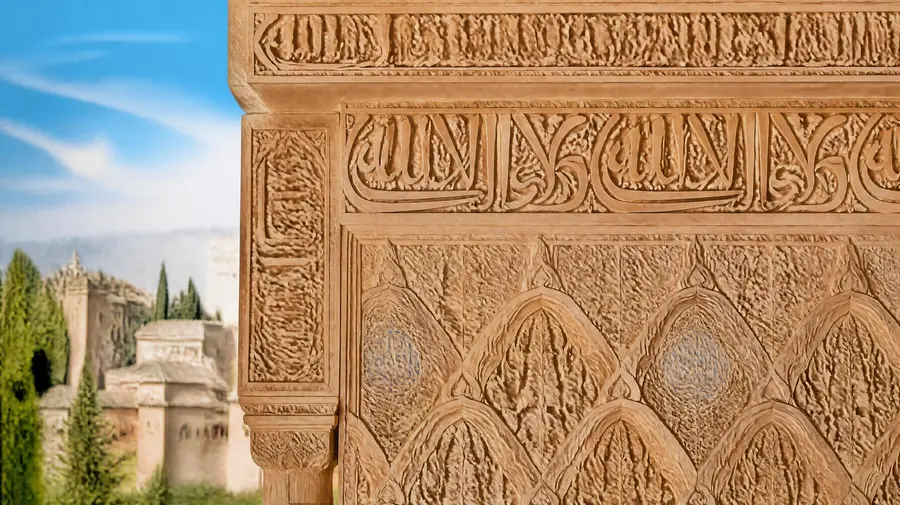
Look at the walls closely when you visit. What looks like wallpaper pattern from four meters away is actually literature. The Nasrid Palaces are quite literally books made of stone. The stucco is covered in thousands of lines of Arabic inscriptions, divided into three distinct categories: religious Quranic verses, poetic praise written by court poets, and political mottos.
The most common phrase repeated across the complex is Wa la ghaliba illa Allah. It translates to: "There is no victor but God."
You see it carved into capitals, stamped across ceramic tiles, and repeated along friezes. Tradition says Ibn al-Ahmar adopted the phrase when returning victorious from battle, refusing to claim personal glory. It is a striking motto for a dynasty that spent two and a half centuries paying tribute to Christian kings, buying time, and knowing the clock was ticking against them.
- Ibn Zamrak's verses: The Court of the Lions features poems written by the grand vizier himself, celebrating the fountain as a pearl pouring melted silver into gardens.
- Cursive vs. Kufic scripts: Look for rigid, angular geometric Arabic script on lower friezes, contrasted with flowing, lyrical cursive writing at eye level.
- Visual optical illusions: Stucco bands widen slightly as they rise up high walls, an intentional trick to correct the viewer's perspective from the floor.
Very little wood was used for structural walls. The artisans worked with simple materials: gypsum plaster, sand, water, and split reeds tied with hemp rope. They cast repetitive molds, carved them while the plaster was still wet, and painted them in brilliant lapis lazuli blues, malachite greens, and gold leaf. The vibrant paint has faded over seven centuries, leaving behind the bare, skeletal white stone that modern cameras capture. In its prime, stepping into these halls was like walking into the inside of an illuminated manuscript.
Frequently Asked Questions about nasrid palaces history
When was the Alhambra built?
Construction on the citadel began in 1238 under Muhammad I, though significant royal expansions continued through the 14th century, particularly under Yusuf I and Muhammad V between 1333 and 1391.
What was the main purpose of the Nasrid Palaces?
They served as both the private residences of the Nasrid sultans and the administrative center of the Emirate of Granada, housing council chambers, private apartments, and ceremonial reception rooms.
Why did the Catholic Monarchs keep the palaces intact?
Ferdinand and Isabella recognized the peerless craftsmanship of the buildings and considered them royal spoils of victory. They maintained the palaces for royal use rather than razing them to the ground.
Quick Reference
- 1238: Dynasty founded by Ibn al-Ahmar
- 1333–1391: Construction of Comares and Lions palaces
- 1492: Surrender of Granada to Catholic Monarchs
- 1812: Napoleonic troops mine towers during retreat
Book your nasrid palaces experience:
My Take
You cannot truly appreciate these halls by rushing from room to room with your phone out trying to capture every archway. Take twenty minutes to lean against the brickwork in the Mexuar, ignore the self-guided audio tour for a moment, and think about the craftsmen who worked these walls knowing their kingdom was shrinking around them year by year. That sense of fleeting, desperate beauty is what makes the stones speak across the centuries.
Read more about nasrid palaces.